
Neglect
Neglect is a strategic priority for Swindon Safeguarding Partnership.
Neglect has been identified in several local Child Safeguarding Practice Reviews and is also a recurring theme nationally. Individual review reports, learning leaflets and the neglect thematic review are available on the Local Child Safeguarding Practice Reviews and Case Learning leaflets page.
The Swindon Neglect Strategy 2026-2029 (PDF) sets out the strategic aims and objectives of Swindon's approach to reducing the number of children experiencing neglect.
Read the Neglect Strategy on a Page: Practitioners and Managers (PDF) for a summary of the strategy and what it means for practitioners and managers.
Watch the Neglect Strategy video briefing (YouTube, 4 minutes 54 seconds).
The Neglect Communication and Culture Strategy (PDF) supports delivery of the Swindon Safeguarding Partnership Neglect Strategy 2026-2029.
Neglect identification tools
- Neglect Identification Tool for Brief Contacts (Word)
- Neglect Identification Tool (full version) (Word)
Quality of care assessment tool
For more guidance on using these tools, open the ‘Identifying and responding to neglect, including neglect identification tools and quality of care assessment tool’ accordion below.
Neglect is defined as:
The persistent failure to meet a child's basic physical and/or psychological needs, likely to result in the serious impairment of the child's health or development. Neglect may occur during pregnancy because of maternal substance abuse. Once a child is born, neglect may involve a parent or carer failing to:
- provide adequate stimulation, food, clothing and shelter, including exclusion from home or abandonment
- protect a child from physical and emotional harm or danger
- ensure adequate supervision, including the use of inadequate caregivers
- ensure access to appropriate medical care or treatment
It may also include neglect of, or unresponsiveness to, a child's basic emotional needs.
Swindon Safeguarding Partnership recognises that neglect does not need to be persistent to negatively affect children, but the effects are cumulative.
Horwath (2007) identified six classifications of neglect:
- medical neglect
- nutritional neglect
- emotional neglect
- educational neglect
- physical neglect
- lack of supervision and guidance
How we understand and define neglect can determine how we respond to it.
Neglect can be difficult to recognise. Having one sign does not necessarily mean that a child is experiencing neglect. Neglect often involves a failure to act rather than an intentional act, which can make it difficult for professionals to recognise.
For further information, see the domains of neglect in the SSP Neglect Framework and Practice Guidance (PDF).
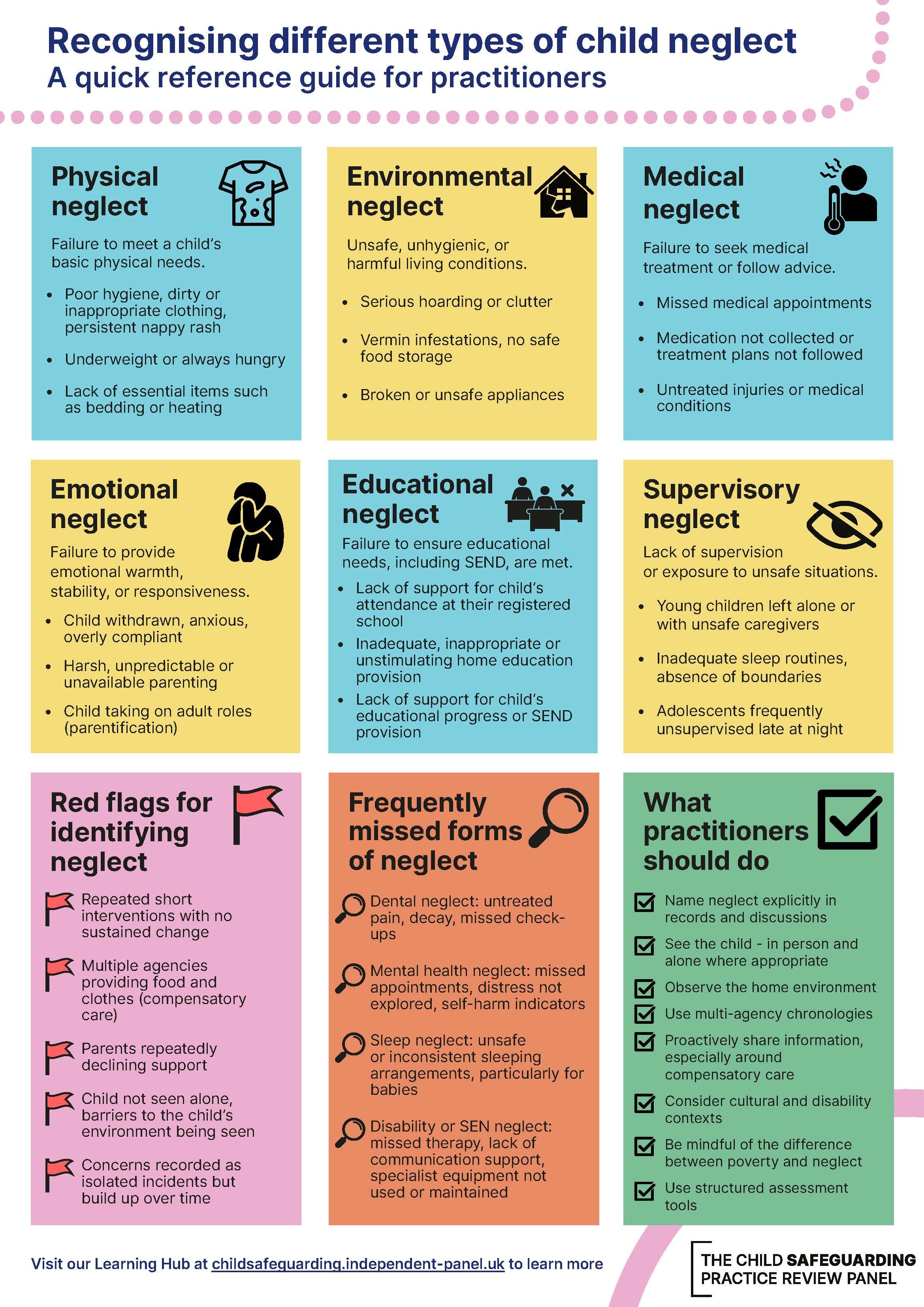
Read or download the Recognising different types of neglect poster (PDF) from the Child Safeguarding Practice Review Panel.
Poverty and neglect
Poverty and neglect are not the same. Families experiencing financial hardship may face significant challenges meeting children's needs despite making considerable efforts to do so.
Professionals should distinguish between:
- difficulties arising primarily from poverty, housing shortages or structural disadvantage
- concerns arising from a parent's inability or unwillingness to prioritise and meet a child's needs when support and resources are available
Assessments should consider the impact of:
- financial hardship
- housing conditions and availability
- access to services and transport
- social isolation and exclusion
- wider inequalities affecting the family
Where unmet needs are primarily related to poverty, practitioners should seek to reduce barriers and improve access to support rather than viewing these difficulties as evidence of neglect.
Affluent neglect
Affluent neglect is neglect experienced by children in wealthy families. It can be more difficult to spot, as the neglect experienced by children in these circumstances is often emotional.
Children from all walks of life face risks. Being a child in an affluent family is sometimes perceived to offer protection from these dangers. However, children from wealthier or apparently more stable families can also experience neglect.
Source: Neglect and Affluent Neglect, Merton Safeguarding Children Partnership.
Read the Affluent neglect (PDF).
Adolescent neglect
The signs of neglect in older children may be more difficult to identify than in younger children or babies. Older children may spend more time away from a neglectful home. This can increase their vulnerability to going missing, offending behaviour or exploitation.
Without recognising the impact of neglect at home, practitioners' responses may not meet the child's support needs.
Older children may appear 'resilient' or be perceived as making choices about their lives when they are using unsafe coping mechanisms. Practitioners should be aware of adultification and the language they use about children. Read more about adultification (PDF).
Parents may not always be equipped to help older children deal with increased risks outside the home.
The impact of neglect on older children can be significant and, in some cases, life-threatening. Neglect can lead to difficulties in adolescence and adulthood, including:
- poor mental and physical health
- difficulties with personal relationships
- offending behaviour
- substance misuse
- increased risk-taking behaviour
- suicide
Further guidance on adolescent neglect is available in the SSP Children's Neglect Framework and Practice Guidance (PDF).
For additional resources, see the section below, "What is it like to be a child in this family or household on a daily basis?"
Disabled children and neglect
Research indicates that disabled children are at greater risk of abuse than non-disabled children. It is estimated that disabled children are three to four times more likely to be abused or neglected. They are more likely to be abused by someone in their family, and the majority of disabled children who experience abuse are abused by someone known to them.
This analysis covers a wide range of disabilities, including physical and sensory impairments, mental illness, intellectual impairments and long-term health problems.
Recognising signs of neglect
Possible indicators include:
- a parent or carer does not recognise the identity of a child with a disability and is negative about the child
- a parent or carer does not ensure that health needs relating to the disability are met, resulting in deterioration in the child's condition
- a parent or carer does not support a child's use of communication aids, attend follow-up appointments or maintain equipment
- a parent or carer does not follow a dietitian's advice, for example where oral feeding creates a risk of aspiration
- a parent or carer does not follow professional advice or support and is hostile to seeking help for the child
- a carer overmedicates the child
- parents' own difficulties affect their ability to respond to a disabled child's urgent health needs
- a change in behaviour that is not typical for the child and may indicate harm from another person, for example sexualised behaviours involving toys
For further information, see Neglect in Disabled Children, Hampshire Safeguarding Children Partnership (2021).
For additional resources, see the section below, "What is it like to be a child in this family or household on a daily basis?"
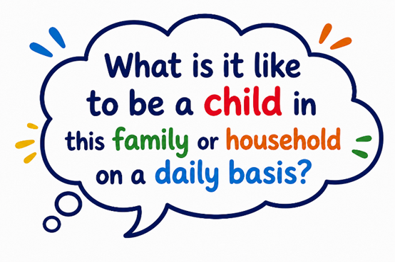
The question practitioners should always ask themselves is:
What is it like to be a child in this family or household on a daily basis?
The SSP Neglect Framework and Practice Guidance (PDF) explains how to identify neglect and how to respond.
When professionals have concerns that a child is experiencing neglect, they are expected to use the Neglect Framework to make an early, proactive assessment of the impact on the child.
The Right Help at the Right Time multi-agency threshold guidance (PDF) can also help practitioners assess levels of need and identify appropriate support.
Further information is available on The Right Help at the Right Time: Swindon's Multi-Agency Threshold Guidance page.
Neglect identification tools
There are two Neglect Identification Tools to help practitioners recognise and identify possible signs of neglect at the earliest opportunity.
The tools should be used when there are emerging concerns or when professionals need to decide whether neglect may be present. They support, rather than replace, professional judgement.
Neglect Identification Tool for Brief Contacts (Word) is a shorter version for practitioners who have had limited or one-off contact with a child but have concerns about the care they may be receiving.
It focuses on observable indicators of neglect, the child's lived experience and whether further assessment, information sharing or intervention is needed.
Neglect Identification Tool (full version) (Word) is for practitioners who are involved with a child and family and have information from direct work, partner agencies, supervision or case records.
It supports deeper reflection on the child's lived experience, the impact of neglect, parental capacity to change, risk and the effectiveness of interventions. The tool supports decision-making.
Quality of care assessment tool
The Quality of Care Assessment Tool helps practitioners understand a child's lived experience, the cumulative impact of neglect over time and the support or interventions needed.
The following resources will help you complete the assessment:
- Neglect Quality of Care Assessment Tool Guidance (PDF)
- Neglect Quality of Care Assessment Tool Quick Guidance (PDF)
- Neglect Quality of Care Assessment Tool (Word)
- Neglect Identification Tool and Quality of Care Assessment Tool training slides (PowerPoint, includes recorded audio)
To hear the recorded audio, download and open the PowerPoint presentation, then play it in Slide Show mode.
You can also watch the Neglect Identification Tool and Quality of Care Assessment Tool training (YouTube, 23 minutes 3 seconds).
Please provide feedback about your use of the Quality of Care Assessment Tool using the Swindon Safeguarding Partnership Quality of Care Assessment feedback form.
Remember: If you are concerned that a child or young person has suffered harm, neglect or abuse, contact Children and Families Contact Swindon. If a child is at immediate risk of harm, call the police on 999.
The Day in My Life tools can help you work with children and families to understand a child's lived experience. They help practitioners understand what is happening in families where neglect may be an issue and what could improve outcomes for children.
There are six versions of the tool for different ages and needs:
- Day in my life: Unborn baby (PDF)
- Day in my life: Baby (PDF)
- Day in my life: Pre-school child (PDF)
- Day in my life: Primary school-aged child (Word)
- Day in my life: Adolescent (PDF)
- Day in my life: Child with disabilities (PDF)
Use the Day in My Life guide (PDF) for advice on completing these tools.
Other resources to support understanding a child's lived experience
Appendix 1 of the SSP Neglect Framework and Practice Guidance (PDF) contains questions to help practitioners understand children's lived experience of neglect.
Read Appendix 1: Questions for practitioners in understanding children's lived experience of neglect (PDF).
Communicating: Listening Beyond Words (YouTube, 38 minutes 53 seconds) is a recorded presentation by colleagues from the Disabled Children's Team about communicating with disabled children and young people.
Resources accompanying the recording are also available on the Practitioner Forum and Child Sexual Abuse page:
Prochaska and DiClemente's model (1983) describes the stages people may go through when changing their behaviour. It can help practitioners understand where someone is in the change process.
The model applies to all types of desired change and describes five stages people may move through when changing behaviour. It may be helpful when assessing parental capacity to change.
Resources:
Talking to parents or carers about neglect can feel uncomfortable and challenging.
Read the top tips on having courageous conversations (PDF) with parents or carers.
These resources can also help:
Supervision
- Defensible decision-making in children's social care: Resource pack for practice supervisors (2022). This includes a downloadable resource pack and may also be useful to partner agencies.
- Neglect supervision guide (PDF)
- Supervision management oversight: Learning from audits (PDF)
Seven-minute and practice briefs
- Capturing the voice of the child in records (PDF)
- Be AWARE: Police safeguarding graphic (PDF)
- Voice of the child: Learning from case reviews briefing (PDF)
- Resource pack: Professional curiosity (PDF)
- Safeguarding unborn babies: Seven-minute brief (PDF)
- Safeguarding children: Oral health (PowerPoint)
- SSP practice brief: Working with resistance or disguised compliance (PDF)
- Neglect Awareness presentation (PowerPoint, includes audio)
- Cumulative harm: Neglect (PDF)
- Neurodiversity information and resources for practitioners (PDF)
- SSP safeguarding theme June: Child neglect (PDF)
SSP procedures and guidance
- The Right Help at the Right Time: Swindon's Multi-Agency Threshold Guidance
- SSP chronology guidance and chronology template (Word documents)
- Think Family Practice Guidance (November 2023) (PDF)
- Guide to safeguarding and supporting young people (PDF)
SSP posters and checklists
See the Posters for professionals page for further resources.
- Being professionally curious: Top tips poster (PDF)
- Child neglect: Cumulative impact poster (PDF)
- Child neglect: Resources poster (PDF)
- Child neglect graphics for use in communications (November 2026) (Word)
- Professional curiosity poster (PDF)
- Self-neglect poster (PDF)
- Think Family practitioner checklist (PDF)
- Working with Men: Practitioner Checklist 2026 (PDF)
SSP webpages
- Information sharing and consent
- Professional curiosity
- Adult and children resolution policy
- Working with fathers and male caregivers
- Safeguarding unborn babies, children under one and working with fathers
- Child exploitation: Harm outside the home
- Self-neglect
Recordings
- Learning from reviews: Alan and Tristan
- Recurring learning themes from reviews and audits
- Spotlight on child neglect
- Spotlight on learning from Local Child Safeguarding Practice Reviews and the thematic review 'Why doesn't anything change?'
- Spotlight on learning from reviews: Child neglect and self-neglect
- Practitioner Forum and Child Neglect
- Communicating: Listening Beyond Words (15 October 2025) (YouTube, 38 minutes 53 seconds). A recorded presentation by the Disabled Children's Team about communicating with disabled children and young people. Related materials are referenced on the Practitioner Forum and Child Sexual Abuse page.
- Safeguarding children: Dental health
Resources about poverty and neglect
Andrew Freeman and Eavan McKay from the NSPCC presented on the relationship between poverty and neglect at the Spotlight on Child Neglect event.
- The relationship between poverty and neglect: NSPCC (YouTube, 26 minutes 7 seconds)
- The relationship between poverty and neglect: NSPCC (PDF)
SSP training
Motivational interviewing and communication skills can help practitioners support people to make changes to their behaviour. Read Motivational interviewing: What it is and how you can use it in social work.
Free face-to-face training is being delivered by professionals from the Family Nurse Partnership and Swindon Borough Council. Some places are available to professionals across the safeguarding partnership. Find out more about motivational interviewing and communication skills training.
Other useful resources
- Neglect: Child Safeguarding Practice Review Panel
- Neglect is also child abuse: NSPCC
- Neglect: Learning from case reviews, NSPCC Learning (2022)
- Too little, too late: Identifying and tackling neglect, NSPCC Learning
- Statistics on child neglect: NSPCC Learning
- Ecomaps: Safeguarding Network
- Ecomaps: Guide, examples and templates for social workers
We welcome your feedback about the information and resources on this page. Complete the Neglect page feedback form.